
Sand Driving vs Circuit Driving: What Is the Difference?
If you have driven a car on normal roads, you already know more about driving than you might think.
Maybe you’ve even driven on a race circuit.
You know how the car responds when you turn the steering wheel. You know roughly how much space you need to brake. You know that if you press the accelerator, the car moves forward and if you turn the wheel, the car follows the direction you choose.
Then you drive onto sand.
Suddenly, the car feels different. The steering can feel lighter. The tyres don’t seem to grip in the same way. You can’t treat the accelerator and brakes exactly as you would on tarmac. Even maintaining the right speed becomes a different exercise. So, what actually is the difference between sand driving and circuit driving?
Quite a lot.
Sand and Tarmac Are Completely Different Surfaces
The biggest difference is underneath the tyres.
A race circuit or normal paved road gives you a relatively firm and predictable surface. The tyres have a stable surface to work against, so steering, braking and acceleration are comparatively consistent.
Sand moves.
Put the weight of a vehicle onto soft sand and the surface underneath the tyres can shift. Instead of simply rolling over a solid surface, the tyres are interacting with thousands of loose grains. That is why a vehicle can feel perfectly normal on the road and then behave very differently once it enters the desert. It is not necessarily that the car has suddenly become difficult to drive.
The surface has changed.
On a Circuit, Grip Is Usually More Predictable
On a circuit, drivers spend a lot of time thinking about grip. Racing drivers know where they can brake, where they can accelerate and how quickly they can take a corner.
The track has a fixed layout too. You know there is a corner coming up. You know roughly what the surface will look like. You know where the track goes. Even if you are driving quickly, there is a certain predictability to it.
Sand doesn’t give you that luxury.
A dune can be soft in one place and firmer a short distance away. A slope can look easy from a distance and turn out to be much steeper when you reach it.
There isn’t a painted racing line telling you where to go.
The driver has to read the terrain.
Why Tyre Pressure Matters on Sand
This is one of the first things that surprises people who have never driven off-road.
For normal road driving, your tyres are inflated to the pressure recommended for your vehicle.
In soft sand, professional and experienced off-road drivers commonly reduce tyre pressure to increase the tyre’s contact area with the surface. This helps the tyre float over the sand instead of digging into it. The exact pressure depends on the vehicle, tyres, load and sand conditions, so there isn’t one magic number that works for every vehicle.
Think about it this way.
A hard, fully inflated tyre has a relatively small contact patch.
Letting some air out allows the tyre to spread out more.
More tyre touching the sand means the vehicle’s weight is distributed over a larger area.
That can make a big difference in soft sand.
This is one of the reasons you shouldn’t simply take your normal road-driving setup into deep dunes and expect the vehicle to behave the same way.
And there is an important part people sometimes forget:
The tyres need to be inflated again before returning to normal road or highway driving.
Driving long distances on tarmac with significantly underinflated tyres can create excessive heat and handling problems.
Momentum Matters More Than You Might Expect
This is probably one of the strangest things for a first-time sand driver.
On a road, slowing down is often the obvious response when you feel the vehicle losing control.
In soft sand, losing momentum can be exactly what gets you stuck. That doesn’t mean driving as fast as possible.
Quite the opposite.
Sand driving is generally about maintaining controlled momentum.
If you enter soft sand too slowly, the tyres can start digging instead of carrying the vehicle forward.
If you attack a dune too aggressively, you can lose control, spin the tyres or arrive at the crest with too much speed.
The trick is finding a steady pace and making smooth inputs.
This is one of the reasons experienced desert drivers can make sand driving look almost effortless. They’re not fighting the sand all the time. They’re working with it.
Steering on Sand Is Different
On tarmac, you turn the steering wheel and expect the car to respond fairly directly.
On sand, the response can feel softer and less precise.
The front tyres can move slightly through the surface rather than simply gripping and changing direction immediately.
This doesn’t mean you should constantly move the steering wheel from side to side.
Actually, smooth steering is more important.
Sudden steering movements can upset the vehicle, particularly when the tyres are running at reduced pressure. Off-road guidance also warns against sharp turns and sudden swerving when tyres are deflated.
So if you are used to circuit driving, don’t think:
“I need to be more aggressive with the steering.”
Usually, you need to be more patient with it.
Braking Is Different Too
A paved circuit gives your brakes a firm surface to work against.
Sand is less predictable.
If you suddenly brake hard on loose sand, the tyres can lose traction and the vehicle can behave differently from what you’re used to. This is another reason experienced sand drivers tend to avoid unnecessary sudden inputs.
Instead of treating every situation like an emergency on a circuit, desert driving often requires you to think a little further ahead.
Look at the dune.
Look at where you’re going.
Think about what is on the other side.
Then decide what the vehicle needs to do.
It sounds simple, but that forward planning matters a lot in the dunes.
A Race Track Has a Route. The Desert Doesn’t.
This might actually be the biggest difference of all.
A circuit tells you where to drive.
The desert doesn’t.
You have dunes, slopes, dips, soft patches and changing terrain.
The driver needs to understand the shape of the dunes and choose a suitable line.
This is particularly important around dune crests.
You cannot always see what is on the other side of a dune, so simply charging toward the top because it looks exciting isn’t a great idea. Experienced drivers read the terrain before committing to an approach. Professional desert-driving guidance also stresses assessing dunes and choosing the route rather than treating every dune as something to attack at full speed.
That is one of the reasons dune driving is a skill in its own right.
Does Circuit Driving Experience Help With Sand Driving?
Yes, but only to a point.
If you’ve driven on a circuit, you probably already understand things such as vehicle balance, throttle control, steering and looking ahead.
Those skills are useful.
But sand introduces a completely different surface.
You still need to learn how the vehicle behaves when the tyres are moving through loose sand, how momentum works on dunes and how to judge the terrain.
So having circuit experience doesn’t automatically make someone a good sand driver.
A person can be very comfortable driving quickly around a circuit and still make basic mistakes in the desert.
The two experiences overlap in some areas, but they are definitely not the same thing.
Sand Driving Is Not About Driving Fast
This is worth saying because videos of dune driving can give the wrong impression.
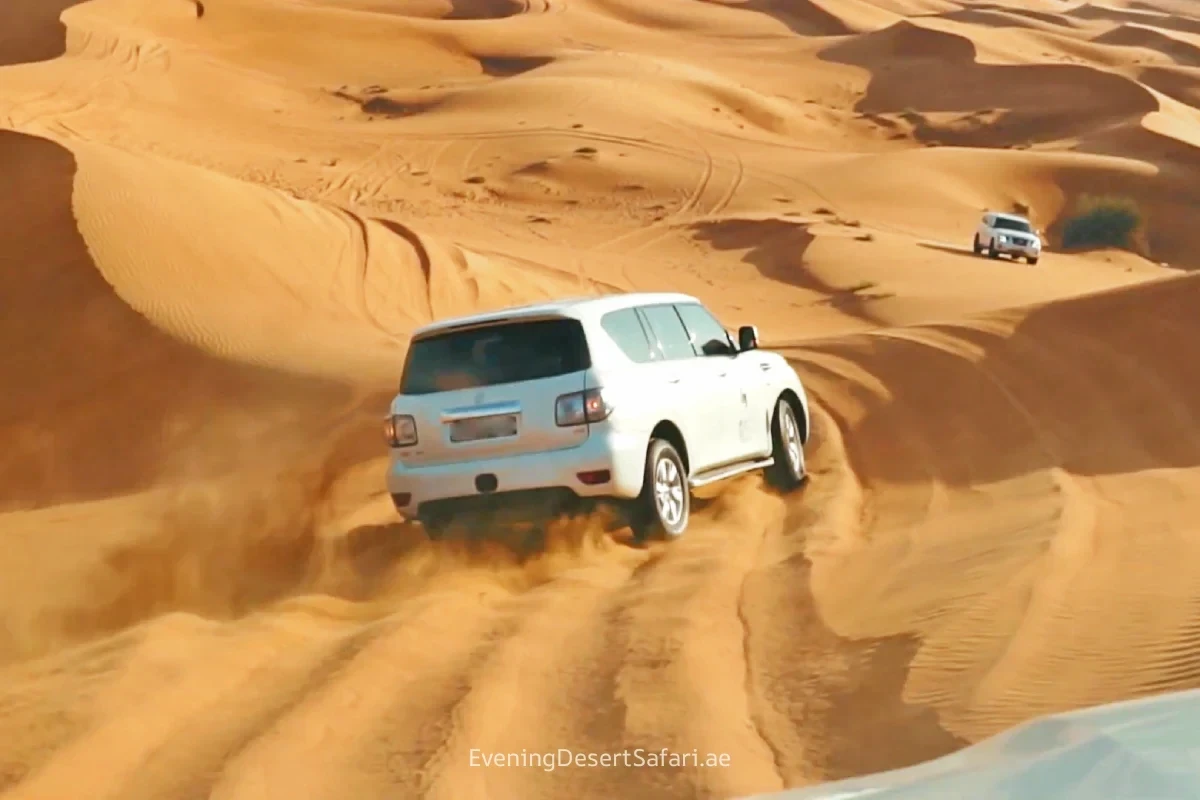
You see a 4×4 climbing a huge dune, sliding down the other side and throwing sand everywhere.
It looks like pure speed.
There is certainly an element of excitement, but good sand driving is much more about control than simply going fast.
The driver has to manage:
- Throttle
- Steering
- Momentum
- Tyre pressure
- Dune angle
- Vehicle position
- Visibility
- The condition of the sand
And sometimes the smartest decision is not to take a particular line at all.
That is something you don’t always appreciate until you’ve actually spent time in the desert.
What About Dune Bashing in Dubai?
Dune bashing is a good example of how different desert driving is from circuit driving.
During a Dubai desert safari, an experienced driver takes the vehicle across dunes rather than following a fixed road or track. The vehicle may climb a dune, descend another, travel across softer sand and change direction according to the terrain. It looks chaotic from the passenger seat sometimes.
From the driver’s point of view, there is a lot going on.
The driver is constantly reading the sand and adjusting the vehicle. That is why dune bashing should not be treated as something you can safely copy after watching a few videos online.
Professional experience matters.
Can You Experience Sand Driving Yourself?
Yes, and you don’t necessarily need to own a 4×4.
One of the easier ways for visitors to experience driving on desert sand is through a guided dune buggy tour in Dubai.
A dune buggy gives you a very different experience from sitting in the passenger seat of a desert safari vehicle. You are actually controlling the vehicle while a guide leads the group through the desert. Depending on the buggy and tour, you can ride across open desert and larger dunes rather than being restricted to a paved circuit.
If you’d rather experience the desert with an ATV, guided quad biking in Dubai is another option.
The important part is that these experiences are conducted in the environment they are designed for, with suitable vehicles and guidance.
Sand Driving vs Circuit Driving: Which Is Harder?
There isn’t really one answer.
It depends on what you’re used to.
A racing circuit can be extremely demanding if you’re trying to drive quickly and consistently. There is a lot of skill involved in braking points, cornering, acceleration and vehicle control.
Sand is difficult for a different reason.
The surface itself keeps changing. You have less predictable traction, loose terrain and dunes that need to be read rather than simply followed. For someone who has never driven on sand, the first few minutes can feel surprisingly strange. The car doesn’t behave like it does on the road.
And that’s exactly what makes desert driving interesting.
The Simple Way to Think About It
If you remember only one thing from this article, remember this:
Circuit driving is about controlling a vehicle on a relatively predictable surface.
Sand driving is about controlling the vehicle while also adapting to the surface underneath it.
The steering is different.
The braking is different.
The tyre setup is different.
The importance of momentum is different.
And, perhaps most importantly, the road doesn’t tell you where to go.
The desert does.
You just have to learn how to read it.
Frequently Asked Questions
Is driving on sand harder than driving on a circuit?
Not necessarily harder, but it requires a different set of skills. Sand has changing traction and terrain, while a circuit offers a much more predictable surface and fixed route.
Why do you lower tyre pressure when driving on sand?
Reducing tyre pressure increases the tyre’s footprint, helping spread the vehicle’s weight over a larger area. This can improve flotation and reduce the tendency of the tyres to dig into soft sand. The correct pressure varies by vehicle and conditions.
Can a normal car drive on desert sand?
Some vehicles can manage firm desert tracks, but soft dunes are a different matter. A suitable 4×4 or purpose-built off-road vehicle is much better suited to deep sand. If you are visiting Dubai and want to experience dune driving, using a professional tour operator is a much safer option than taking an ordinary rental car into the dunes.
Why is momentum important in sand?
Maintaining controlled momentum helps prevent the vehicle from losing forward movement and digging into soft sand. It doesn’t mean driving recklessly or as fast as possible.
Is dune driving the same as circuit driving?
No. There are some transferable driving skills, but the surface, traction, vehicle setup and route are completely different.
Can I try sand driving in Dubai?
Yes. Guided dune buggy and quad bike experiences are available in Dubai, while desert safari tours allow you to experience dune driving as a passenger with an experienced driver.
Bottom Line
Driving on sand looks easy when somebody experienced is doing it. That’s usually the funny part.
You watch a skilled driver move across the dunes and think, “What’s so difficult about that?”
Then the road disappears, the tyres sink slightly into the sand and the steering suddenly feels different. You realise pretty quickly that sand has its own rules.
And once you understand those rules, that’s when desert driving starts to make sense.